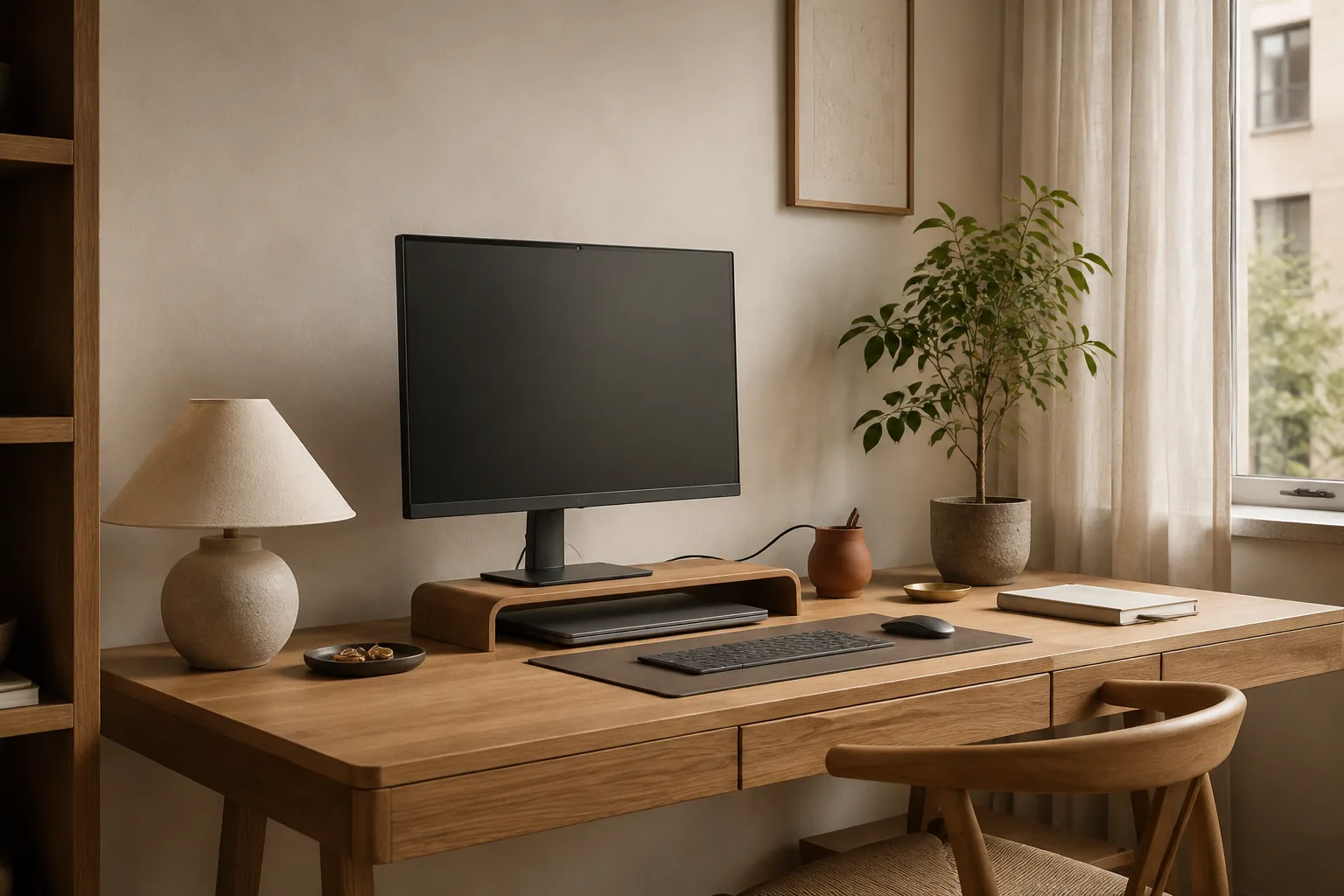
The best desk setup ideas for a small home office start with one simple rule: the desk has to support more than one moment of the day. It needs to hold focused work, a quick call and the small reset between them without becoming a pile of equipment.
1. Give the desk two clear modes
Begin by deciding what must stay on the surface and what only appears when you need it. A monitor, keyboard, lamp and notebook may be permanent residents. A second laptop, paperwork or a tablet can have a nearby shelf, drawer or tray instead.
This is one of the most useful small desk setup ideas because it protects the centre of the worktop. You can still make the corner feel personal; the difference is that every object has a home when the workday changes shape.
2. Raise the screen, not the clutter
Small desks often lose usable space because the screen sits low and the accessories spread around it. A laptop stand or the best monitor stand for your dimensions can raise the display, improve the viewing angle and create a little room underneath.
If you move between rooms, choose a light stand that folds or stores easily. If the desk is permanent, stability and height range matter more than portability. For laptop users, a good answer to the search “best laptop stand for desk” leaves space for a separate keyboard while keeping the screen at a comfortable height.
Measure before choosing a stand
Measure the desk depth, the distance to the wall and the height of the person using it. A stand that looks compact can still push the screen too far forward. The best layout leaves a clear strip in front for writing, charging or simply resting your hands.
3. Use one useful layer of storage
When comparing the best desk shelf options, look beyond the decorative platform. On a small home office desk it can create a second level for speakers, notebooks or a small lamp while keeping the main work zone open. Check the width of the monitor base and the depth needed for the objects you actually use.
If a shelf feels too large, use a narrow tray or an under-desk drawer instead. The principle is the same: storage should be close enough to use without turning every change of task into a tidy-up.
4. Choose light that belongs to the routine
Good lighting makes a compact office feel more comfortable without needing another large object. When comparing the best desk lamp for home office options, choose one that fits beside the screen, moves when the page moves and dims enough for evening work. A softer wall or monitor light can help when the desk has no room for a wide lamp base.
Warm materials do the rest. Wood, paper, a fabric mat or one ceramic object can connect the desk to the room. The goal is not to decorate every empty corner; it is to keep the things you see during a workday pleasant and easy to live with.
5. Make the small things disappear on purpose
The best desk organizer ideas are simple: keep daily tools together, hide the backup items and leave one visible object that makes the space feel like yours. A shallow tray can hold pens and adapters. A drawer can take care of cables, spare drives and the things that otherwise migrate across the desk.
Do not organize by object type alone. Organize by the moment you need it. If the notebook and pen are used together, they should live together. If a charger is needed only once a week, it can move further away.
6. A small-office layout worth copying
Use the back third of the desk for the monitor or laptop stand. Keep the centre open for the current task. Put charging and cable routing at one side, then give the opposite side a small landing zone for a notebook or drink.
| Desk zone | What belongs there | Why it works |
|---|---|---|
| Back edge | Monitor, stand, shelf or lamp | Uses height and protects the writing area |
| Centre | Keyboard, notebook and current task | Keeps the main action easy to reach |
| Side access | Charging cable, cup or small tray | Stops everyday movement crossing the desk |
| Below the surface | Spare cables, adapters and backups | Reduces visual noise without losing access |
FAQ: small home-office desk setups
How do I make a small desk feel bigger?
Raise the screen, move power and spare items below or behind the desk, and keep the centre open. A clear working zone usually adds more value than a larger collection of organizers.
Should a small desk have a shelf?
It can, if the shelf creates a useful second layer without blocking the screen or making the desk feel top-heavy. Measure first and choose a depth that matches the objects you plan to keep there.
How can I make a home-office desk feel less sterile?
Add one or two tactile materials that you will see every day: wood, paper, fabric or ceramic. Keep the useful objects visible and let the decorative ones stay limited.
This is an informational guide. Product links may be added later, after details, availability and any partner terms have been checked.