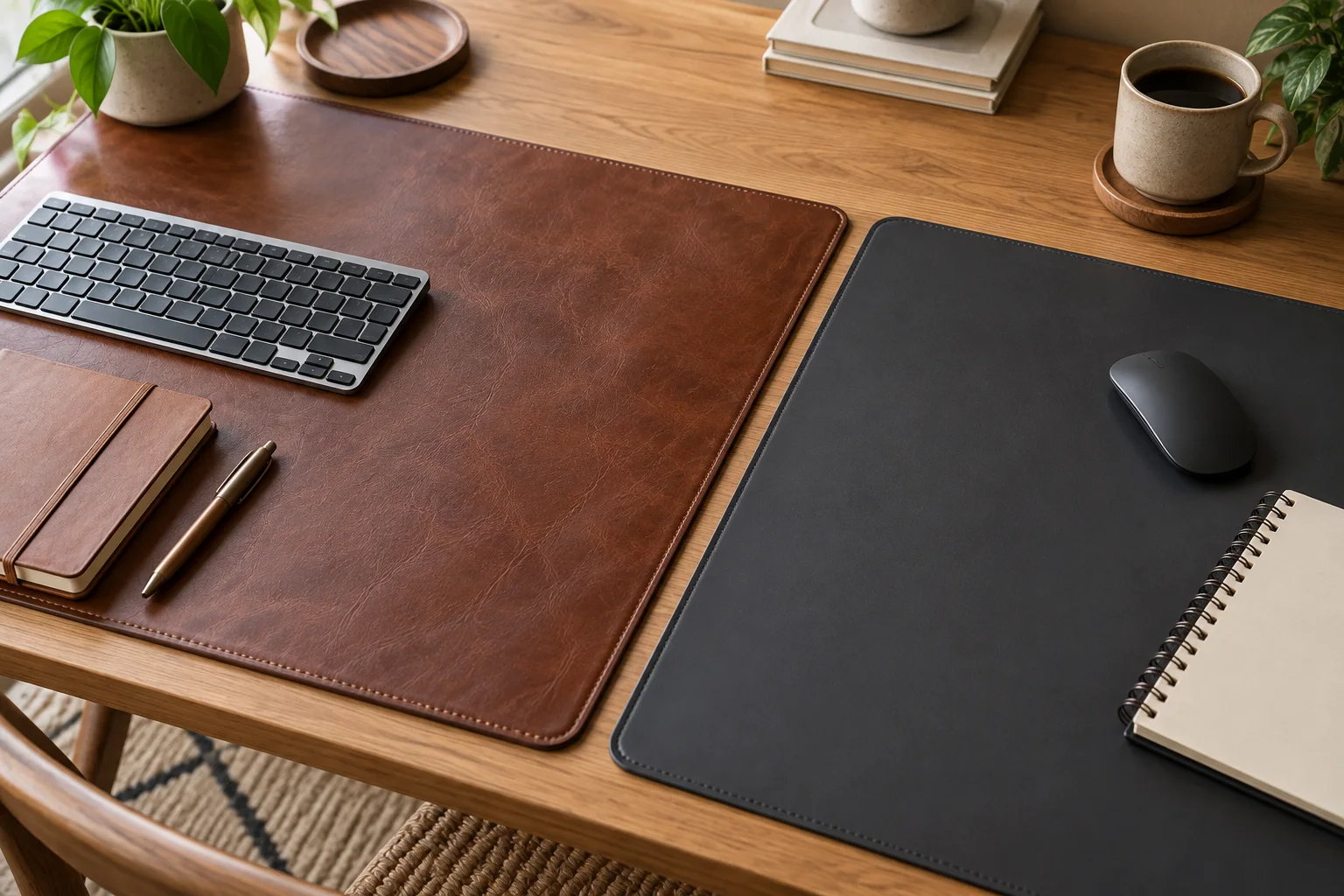
The best leather desk mat is the one that matches the size of your work, the feel you prefer and the maintenance you are willing to do. Start by separating genuine leather from PU leather, then compare the finish, edge, backing, dimensions and how the mat behaves under a keyboard, notebook and mouse.
Quick answer
Choose material after measuring the routine.
Map the keyboard, mouse travel and writing area first. Genuine leather offers natural variation and a material that can change with age; PU leather offers a more uniform surface and often a simpler replace-and-refresh routine. Neither label alone proves quality.
Start with
size · surface · backing · care
Genuine leather vs PU leather
“Leather desk mat” is not a complete material description. Genuine leather is animal hide that may be finished, corrected, coated or split in different ways. PU leather usually describes a polyurethane surface or coating, often on a textile or other backing. Listings can use loose marketing language, so read the material breakdown instead of inferring it from a photograph.
| Material | What may appeal | What to check |
|---|---|---|
| Genuine leather | Natural grain variation, tactile warmth and a surface that may develop patina. | Finish, edge treatment, thickness, backing, care and tolerance for marks or color change. |
| PU leather | Uniform appearance, broad color choice and a surface that can feel consistent out of the box. | Top-layer construction, backing, edge sealing, odor, heat and the maker’s cleaning limits. |
| Unknown or vague material | Possibly inexpensive or visually close to the intended style. | Do not call it genuine leather without a clear material statement. |
A genuine leather desk mat is not automatically more durable, and a PU leather desk mat is not automatically disposable. Thickness, finish, backing, storage and exposure to heat or spills all affect daily life. Your best comparison is the exact product specification and care sheet.
Size, edge and backing decide the feel
Measure the working zone
Place the keyboard where you normally type and trace the mouse path on both sides. Add the notebook or writing area if it belongs on the mat. Leave a comfortable front margin so your wrists do not meet a sharp edge. A mat that is too small looks tidy but pushes the mouse off the surface; one that is too large can catch a drawer, stand or desk edge.
Look at the underside
A desk mat can slide, curl or trap crumbs depending on its backing. Check whether the underside is leather, textile, rubber-like or unspecified, and whether the material is suitable for the desk finish. A heavy mat may lie flatter; a thin mat may be easier to move but more sensitive to an uneven surface.
Inspect the edge
Stitching, painted edges and folded edges age differently. The edge is where your arm touches the mat and where a thin surface can start to lift. Look for even construction, a finish that matches the care instructions and corners that do not curl when the mat is rolled or stored.
Choose a surface for the objects on it
A smooth mat can make mouse movement feel predictable, while a more textured finish may make writing or a notebook feel anchored. A keyboard can hide small surface variation, but a mouse reveals it quickly. If you use a trackball, stylus or paper every day, include those movements in the test. A desk mat is part of the interface between your hand and the desk, not only a decorative rectangle.
Color and grain also change how dust, fingerprints and small scratches read. Dark uniform PU can show crumbs; a varied genuine leather finish can disguise some marks but make a spill more visible. Choose the look you can live with after a month, not only in the listing photograph.
Care without guessing
- Read the material-specific care instructions before the first spill.
- Use a soft dry or slightly damp cloth only when the guidance allows it.
- Blot liquid promptly rather than spreading it across the surface.
- Keep the mat away from direct heat, damp storage and aggressive household cleaners unless the maker explicitly approves them.
- Test any conditioner or cleaner on a hidden edge and stop if color or finish changes.
- Store it flat or in the way the maker recommends; do not force a curled mat under a heavy object and expect it to recover.
If you need a washable desk surface with no material ambiguity, a textile or synthetic mat may be the more honest fit. The best choice is the one whose care matches your actual desk habits.
A simple leather desk mat checklist
Before you compare options, record the desk width, desired front edge, keyboard and mouse zone, preferred surface feel, backing, edge construction and care limits. Confirm the exact material description, dimensions and return conditions. Do not infer genuine leather from grain alone or call a product “best” without checking how it fits your desk.
Reference points
- How to Clean a Desk Mat — start care with the material and maker’s instructions.
- DeskSetup Lab method — compare a desk object by fit and daily use, not a headline alone.
Leather desk mat FAQ
What is the best leather desk mat for most desks?
The best leather desk mat is the size, surface and material that suit your desk and care habits. Choose genuine leather when natural variation and repairable aging matter; choose PU leather when a uniform surface and simpler replacement fit the routine better.
Is genuine leather better than PU leather for a desk mat?
Neither is automatically better. Genuine leather develops variation and may last differently depending on finish and care, while PU leather is more uniform and often easier to treat as a replaceable desk surface. Compare the actual construction and care instructions.
How large should a leather desk mat be?
Measure the keyboard, mouse movement and writing area you want to protect, then leave enough margin to keep the front edge comfortable. A mat should fit the desk routine without catching a monitor stand, drawer or desk edge.
Can I clean a leather desk mat with household cleaner?
Do not assume a household cleaner is safe. Follow the maker’s care guidance, test any approved product on an inconspicuous area and wipe spills promptly. Genuine leather and PU finishes can react differently.