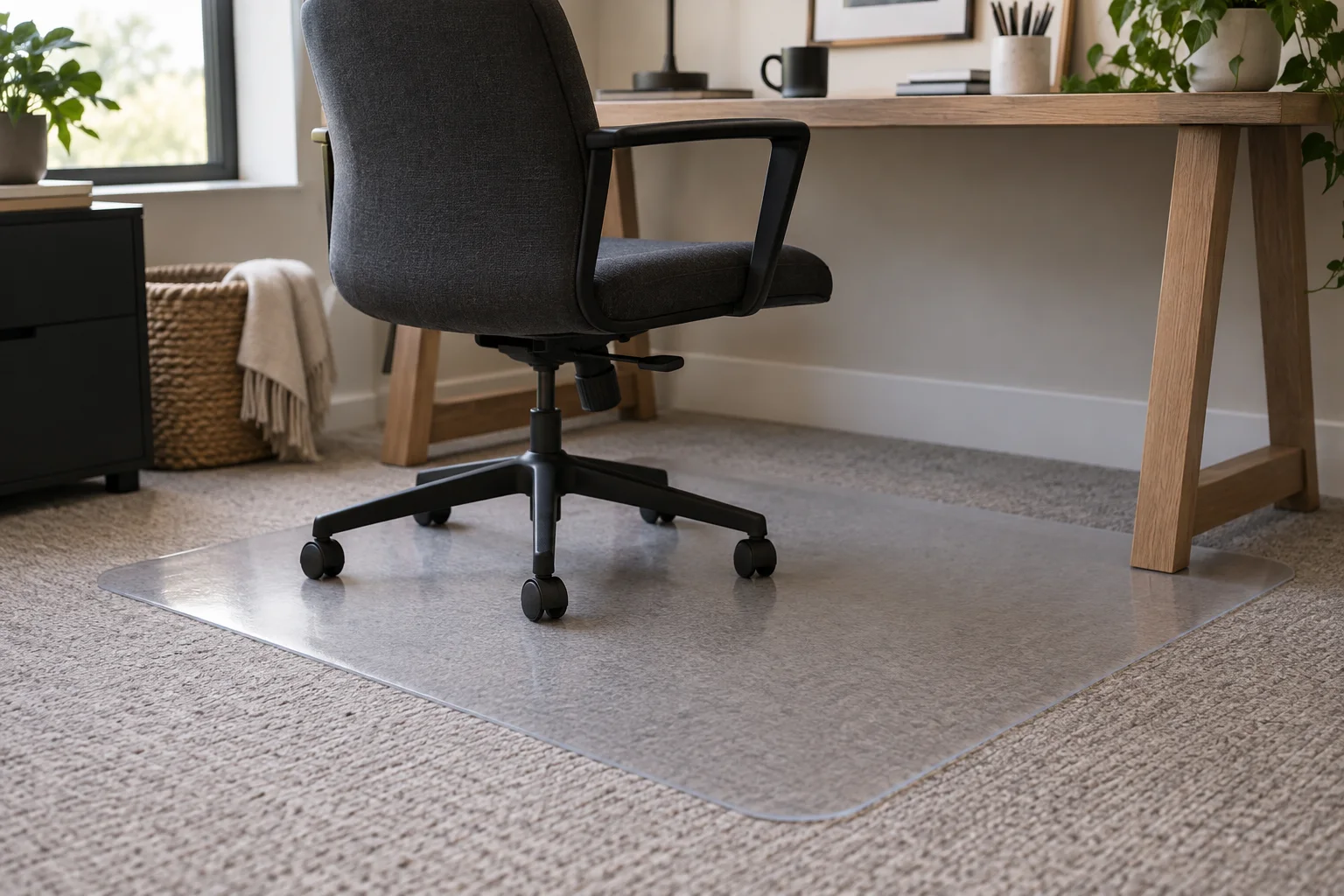
The best desk chair mat for carpet is the one whose backing and structure are specified for your carpet’s pile and underlay, and whose footprint covers the chair’s real travel without blocking the desk or a doorway. Measure the carpet, check the maker’s compatibility guidance and test that the mat lies flat and stays stable before regular use.
Quick answer
Choose for the carpet you actually have.
The best desk chair mat for carpet is the one whose backing and structure are specified for your carpet’s pile and underlay, and whose footprint covers the chair’s real travel without blocking the desk or a doorway. Measure the carpet, check the maker’s compatibility guidance and test that the mat lies flat and stays stable before regular use.
Start with
carpet · backing · chair path
Start with the carpet, not the mat photo
Look at the carpet where the chair will roll. Is the pile short and firm, looped, plush, or deep enough to compress under your hand? Is there a separate rug pad or resilient underlay beneath it? If you do not know the construction, measure the carpet pile itself rather than counting the underlay as pile, then check the floor or carpet maker’s care instructions before pressing a rigid surface into place.
Manufacturers use different terms for carpet categories and backing styles. Floortex’s selection guide asks buyers to identify carpet depth and match the mat’s gripper back to it; its care guidance says to test the selected mat on the floor where it will be positioned. Those instructions are useful reminders, not a substitute for the exact model’s current manual. A size or material name alone does not establish compatibility.
Confirm the intended floor type, carpet-pile range, backing and support requirements for the exact mat. If the maker does not give enough detail for your carpet, ask before buying or choose another floor-protection approach.
Match the backing to the floor below
A carpet mat may use molded cleats or another gripping pattern to limit movement. Cleat length and spacing matter: a backing meant for a low, firm pile may not engage correctly in a thicker carpet, while an unsuitable aggressive back could affect delicate fibers or the surface below. A smooth-backed mat designed for hard flooring can drift or sit unevenly on carpet unless its maker specifically approves that use.
Do not assume that every product labelled anti-slip is meant for carpet. Some anti-slip pads are designed for polished hard floors or very low-pile commercial carpet where conventional cleats may not reach the fibers. Read the product’s named surface compatibility and installation directions; if those conflict with a retailer’s short description, use the manufacturer’s instructions.
Check stiffness, support and edge shape
Once the backing fits, ask how the mat will bridge the carpet under a rolling chair. A mat needs enough support for its intended chair load and floor type. A product that is too flexible for the specified surface can dip or flex as a caster crosses it; one that is much more rigid or heavy than the floor can accommodate may be difficult to position safely. Choose from the maker’s stated intended use and load guidance rather than a thickness number copied from another brand.
Inspect the edge, corners and surface texture. A low-profile, beveled edge can make the transition easier to cross, but it still has to sit flat. Keep the edge out of a door swing and away from a walking route. Do not cut a precision-finished mat unless its instructions explicitly allow it: trimming may expose a sharp edge or change the product’s construction.
Measure chair travel and desk clearance
Move the chair through your real workday path: pull back to stand, roll in to type, turn toward storage and reach the edge of your desk. Use painter’s tape to mark that footprint. Include the chair’s rear casters at their farthest normal position and the approach to the desk; a mat that only covers the seat’s resting position may leave the most-used rolling area unprotected.
| Measure or inspect | What to note | Why it affects fit |
|---|---|---|
| Carpet pile | Visible pile height and how firmly it compresses. | Helps compare the floor with the mat maker’s stated carpet range. |
| Underlay and rug pad | Separate layers, seams, soft spots and floor condition. | Changes support and can make a mat rock or flex. |
| Chair route | Forward, backward and turning positions. | Sets a useful footprint and reveals exposed rolling zones. |
| Desk and room | Legs, cable channels, doors and walking paths. | Prevents a covered floor area from becoming a new obstruction. |
Compare the measured zone with the mat’s usable top dimensions, not just the outside package size. Check whether the mat is rectangular, contoured or has a lip that must slide under desk legs. Leave enough clearance for feet and casters to move without repeatedly catching the edge.
Check the chair and casters as a system
Casters are not interchangeable in how they roll. Wheel diameter, tread material, condition and the chair’s total load can change how it crosses a surface. Follow the chair and mat maker’s guidance, and make a slow test pass with the intended chair rather than assuming a universal caster type will work. If a wheel catches, the mat bows, slides or makes the chair harder to move, stop and reassess the combination.
Before regular use, inspect the carpet for grit, moisture, loose threads and seams. Put the mat down on a clean, dry floor and verify that it lies flat. Roll gently across several points, including its edges. Lift it occasionally to clean underneath and look for trapped debris or changes to the carpet; use only the care method allowed by the floor and mat instructions.
Consider a different floor-protection approach
A chair mat is not the only way to handle rolling on carpet. A chair with casters intended for the floor type may be enough for some setups; a separate hard-floor zone or a manufacturer-approved platform may suit others. Compare the full footprint, transitions, maintenance and chair movement before choosing. Do not place a hard-floor mat on carpet simply because the dimensions work.
Reference points
- Floortex: Choose the best chair mat — identifies carpet depth, backing and floor fit as selection checks.
- Floortex: Selection, use and care instructions (PDF) — advises matching gripper back gauge to carpet pile and testing the mat at its intended position.
- How to choose an anti-fatigue mat — another floor-footprint and edge-fit guide.
- How to choose an under-desk footrest — check nearby floor objects and chair clearance.
Chair mats for carpet FAQ
What kind of chair mat works on carpet?
Use a mat whose manufacturer specifies compatibility with your carpet type and pile, including the correct backing. Carpet construction and underlay vary, so confirm the exact product’s current guidance and test fit on the intended floor.
Do chair mats need spikes on carpet?
Some carpet mats use cleats or grippers, but style and length differ. Check the manufacturer’s guidance for your carpet and avoid transferring a hard-floor mat’s instructions to a carpet product.
How thick should a chair mat be for carpet?
There is no safe universal thickness number across brands, materials, chair loads and carpets. Follow the maker’s carpet and load specifications, then check that the mat remains flat and supported with your chair.
How large should a chair mat be?
Measure the full route you use when rolling, turning and pulling away from the desk. Compare that zone with the mat’s usable surface and leave room for doorways, desk supports and foot movement.
Can I use a chair mat on a rug?
Only if the mat maker approves the rug and its underlay. A loose, soft or uneven rug can shift under a rigid mat, so inspect the complete floor stack and test carefully before use.