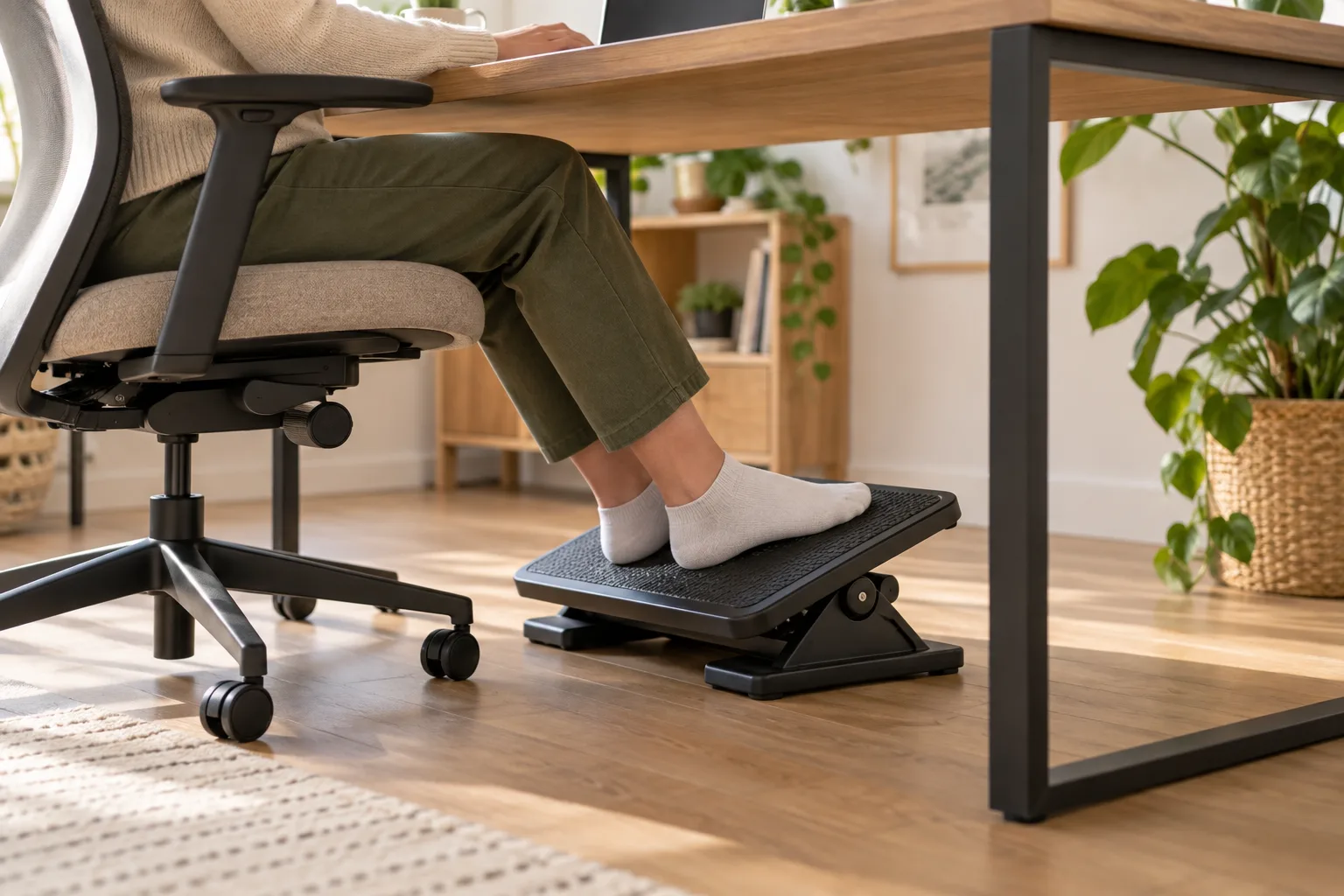
You may benefit from a footrest under your desk when your chair is high enough for the desk but your feet do not rest comfortably on the floor, when the floor is uneven, or when a stable platform helps you change position. It should support relaxed feet without blocking the chair, catching casters or becoming a trip edge. A footrest is a fit tool, not a treatment for persistent pain.
Quick answer
Use a footrest to complete the fit, not to chase a label.
You may benefit from a footrest under your desk when your chair is high enough for the desk but your feet do not rest comfortably on the floor, when the floor is uneven, or when a stable platform helps you change position. It should support relaxed feet without blocking the chair, catching casters or becoming a trip edge. A footrest is a fit tool, not a treatment for persistent pain.
Start with
fit · stability · daily use
What an under-desk footrest can change
The benefit of a footrest is usually geometric. It gives the feet a surface to contact when the chair, desk and floor do not line up comfortably. It can also make a small height adjustment easier, create a predictable place to shift weight and keep feet away from a cold or uneven floor.
That does not mean every desk needs one. If your feet already rest flat or can move freely on the floor, adding a platform may make the area more crowded. A footrest can be useful for one person and inconvenient for another because seat height, leg length, desk depth, shoes and chair movement all change the result.
Words such as ergonomic and anti-fatigue do not tell you whether a platform will fit your knees, chair or desk. Measure the working zone and test the movement you actually use.
Check the desk, chair and feet together
Start with the chair at the height you use for typing. Notice whether your feet touch the floor without reaching, whether your knees are crowded by the desk edge and whether you can move the chair close enough to work without leaning. Record the distance from the floor to the underside of the desk and the clear depth beneath it.
Then check the footrest dimensions: height range, width, depth, tilt, edge shape and underside grip. An adjustable under-desk footrest may let you tune the angle, but adjustment is only useful if the mechanism stays stable and does not steal the space your legs need. Look for a platform large enough for both feet or for the alternating stance you prefer.
| Check | Record | Why it matters |
|---|---|---|
| Foot contact | Flat, partial or no contact at your normal chair height. | Shows whether a platform could complete the floor relationship. |
| Desk underside | Height, supports, crossbars and drawer clearance. | Decides whether knees and the footrest can share the space. |
| Chair movement | Approach, retreat, casters and turning path. | A stable platform is not useful if the chair cannot cross or avoid it. |
| Floor condition | Hard floor, carpet, slope, grit and moisture. | Changes grip, cleaning and the risk of sliding or catching. |
Compare the common footrest types
A fixed platform offers a simple, predictable surface. A rocking or tilting design allows small movement but needs enough space and a stable base. A height-adjustable model can suit more than one user or task, provided the locking or adjustment mechanism does not loosen. Some platforms are soft or cushioned; they may feel different underfoot and can have different cleaning limits.
Do not choose by thickness alone. A thicker platform changes the edge, knee clearance and the chair route. Check whether the maker gives dimensions with the feet or supports included, whether the underside is intended for your floor and whether the surface can be cleaned without trapping moisture.
Run a short, repeatable setup test
- Place the footrest where both feet can reach it without pulling the chair away from the desk.
- Set the lowest useful height first. Keep the feet relaxed and avoid using the platform to push the knees upward.
- Type, read and use the mouse for ten to fifteen minutes. Notice whether the setup lets you change position rather than locking you into one angle.
- Move the chair back and forward slowly. Check whether casters catch the edge, the platform slides or your toes hit the desk support.
- If you use a sit-stand desk, raise and lower it through the positions you actually use. Check that the frame, cables and footrest remain clear.
- Remove the footrest for part of the day and compare the whole setup, not only the first moment of softness.
Keep the test practical. A photograph or a short showroom trial cannot show how the platform behaves after dust, a chair turn, a long call or a change from socks to shoes.
Know what a footrest cannot tell you
A footrest does not diagnose a posture problem or treat pain, numbness or circulation concerns. If discomfort persists, changes suddenly or is accompanied by other symptoms, seek advice from a qualified professional. The article can help you inspect desk geometry; it cannot replace individual medical guidance.
Also check the floor and cleaning instructions. Some rubber-like materials can react with a finish, hold grit against a delicate surface or slide differently on carpet. Lift and inspect the platform periodically, keep the area dry and replace it if the base cracks or loses stability.
Reference points
- How to set up a home office — measure the complete working position.
- How to choose an anti-fatigue mat — floor fit and sit-stand clearance.
- DeskSetup Lab method — compare fit, construction and daily use.
Under-desk footrest FAQ
What are the benefits of a footrest under a desk?
It can give the feet a stable contact surface when the chair, desk and floor do not line up well, and it may make small position changes easier. The benefit depends on fit; it is not a universal ergonomic fix.
Do I need a footrest if my feet touch the floor?
Not necessarily. If your feet already rest comfortably and you can move without crowding the desk, a footrest may add little. Test the complete routine before adding another object.
How high should an under-desk footrest be?
Use the lowest height that lets your feet rest comfortably without pushing your knees up or crowding the desk. Check the chair, desk underside and the platform’s edge together rather than copying a universal number.
Can a footrest help with desk posture?
It can change the floor relationship and may help the whole setup fit, but it cannot correct every desk or chair mismatch and it is not medical treatment. Vary position and seek professional advice for persistent symptoms.